
Acne isn’t just a teenage problem. It follows a huge number of Australian men well into their 20s, 30s and 40s — and for a lot of guys, it actually gets worse as adults because of shaving, sweat, sun exposure and thicker, oilier skin. If you’ve tried “just washing your face” and nothing’s changed, it’s not because acne is impossible to treat. It’s because most routines aren’t built for how men’s skin actually works.
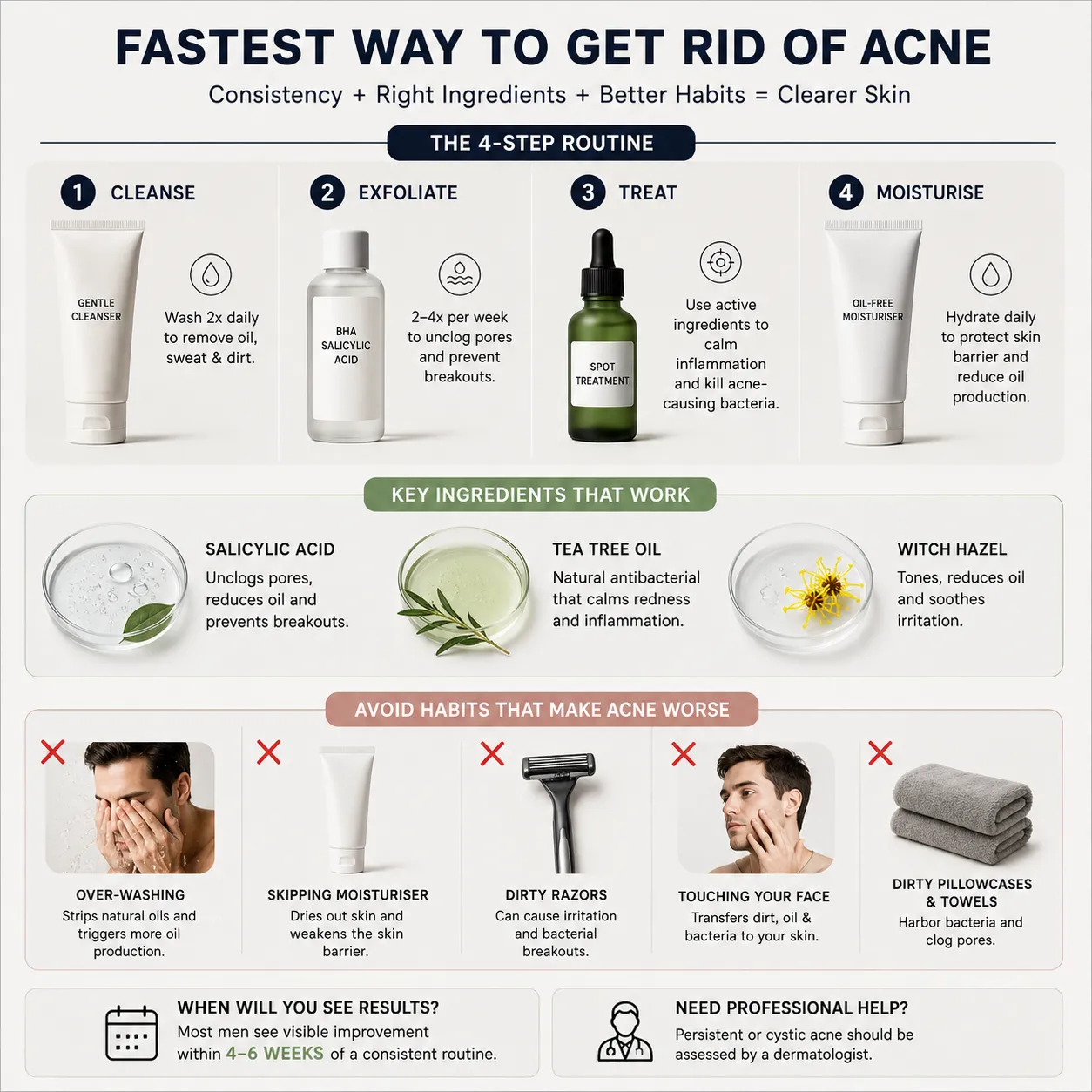
This guide breaks down exactly what causes acne in men, the different types you might be dealing with, and a step-by-step routine — using natural, organic ingredients — that actually addresses the problem instead of just masking it.
Acne happens when hair follicles get clogged with a mix of oil (sebum), dead skin cells, and sometimes bacteria. But why men get clogged pores in the first place usually comes down to a handful of specific triggers.
Testosterone activates the sebaceous glands, which produce oil. More oil means a higher chance of clogged pores. This is why acne often flares during puberty — but hormonal fluctuations from stress, poor sleep, or certain medications can trigger breakouts well into adulthood too.
Hormonal acne isn’t limited to teenagers. Many adult men continue to experience breakouts because testosterone stimulates the sebaceous glands to produce more oil. Excess sebum combines with dead skin cells, creating clogged pores that can develop into inflamed pimples.
Hormonal breakouts often appear along the jawline, chin, neck, chest, and back. Stress, poor sleep, certain medications, and genetic factors can all contribute to flare-ups by influencing hormone levels or increasing oil production.
While a consistent skincare routine can help manage hormonal acne, severe or persistent breakouts may require prescription treatments recommended by a dermatologist.
Men’s skin is typically thicker and oilier than women’s, with larger pores and bigger sebaceous glands. That’s good news for ageing (fewer fine lines) but bad news for acne, since oilier skin is naturally more breakout-prone.
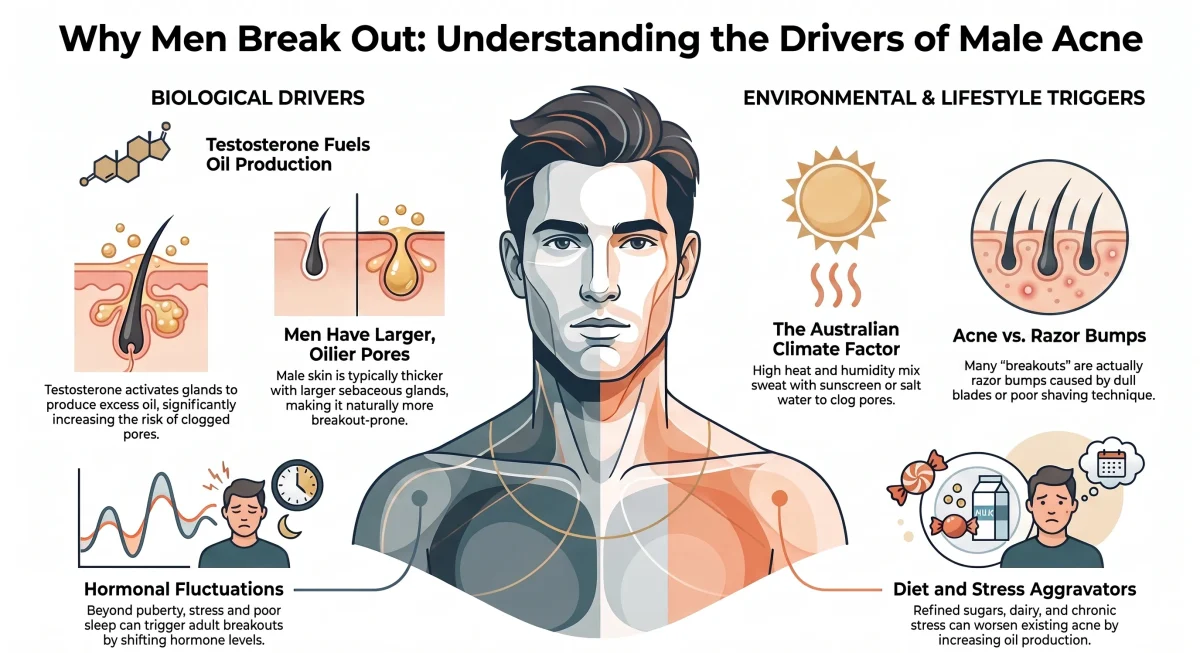
Australia’s heat, humidity and UV intensity are a real factor. Sweat mixed with sunscreen, product build-up, or salt water can clog pores fast — especially on the back, chest and shoulders. If you already deal with heat-related skin issues, our guide on common skin problems in Australian men covers this in more depth.
A lot of what men assume is “acne” around the jawline and neck is actually razor bumps or ingrown hairs caused by dull blades, shaving against the grain, or skipping pre-shave prep. True acne and razor-related breakouts need different treatment approaches — see our section on shaving below.
Diets high in refined sugar and dairy have been linked to increased breakouts in some studies, and chronic stress raises cortisol, which can increase oil production. None of these alone “cause” acne, but they can make an existing tendency worse.
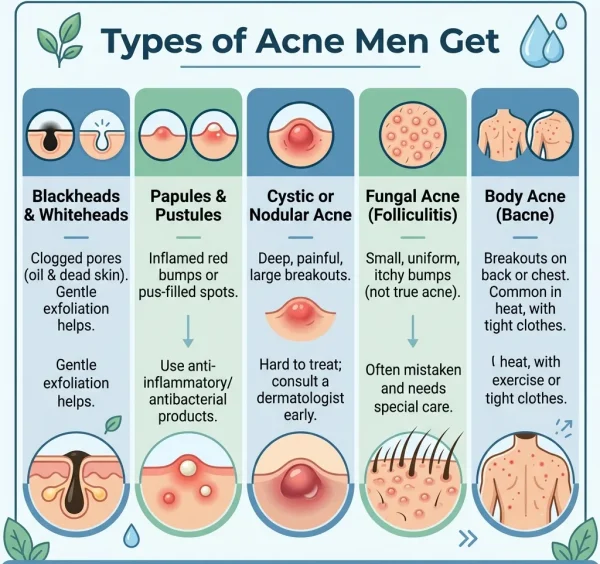
Not all breakouts are the same, and treating the wrong type the wrong way is one of the biggest reasons men feel like “nothing works.”
Clogged pores from excess oil and dead skin. Blackheads are open at the surface (oxidised, hence the dark colour); whiteheads are closed. These respond well to regular, gentle exfoliation.
Small, inflamed red bumps (papules) or pus-filled spots (pustules). This is what most people picture as “a pimple.” Anti-inflammatory, antibacterial ingredients like tea tree oil help here.
Deep, painful, often larger breakouts that sit under the skin. This type is harder to treat at home and is the most likely to leave scarring — it’s the one type where seeing a dermatologist early really matters.
Small, uniform, itchy bumps that don’t respond to normal acne treatment are often folliculitis, an infected hair follicle, not true acne. It’s frequently mistaken for acne and treated the wrong way, which is why it doesn’t clear up.
Extremely common in Australian men, especially those who exercise, wear tight synthetic gym gear, or work outdoors in the heat.
If breakouts on your back or chest are a bigger issue than your face, our complete body skin care guide for Australian men and body wash for men guide go into this specifically.
Here’s the exact order of operations that works for most acne-prone men’s skin. The goal is simple: remove excess oil and dead skin without stripping the skin barrier, because over-drying your skin often triggers more oil production and makes acne worse.
Wash morning and night, and always after a workout or heavy sweating. Use a gentle, non-stripping cleanser rather than a harsh soap bar — bar soap disrupts your skin’s natural pH and can trigger more breakouts. Our Face & Beard Wash – Avocado & Lime cleanses oil and sweat without stripping the skin barrier, which is exactly what acne-prone skin needs.
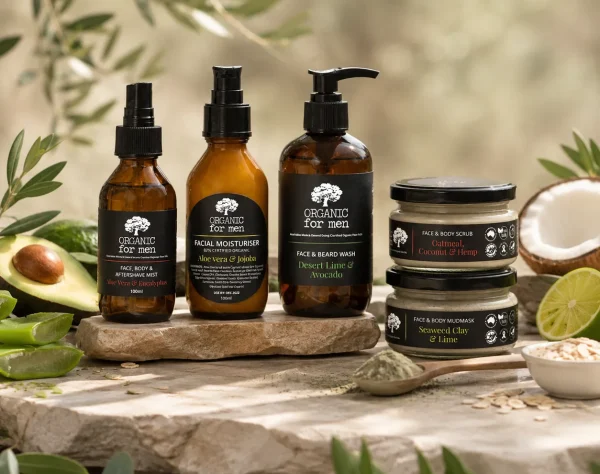
Dead skin cell build-up is one of the main drivers of clogged pores. Exfoliating removes that build-up before it can trap oil and bacteria — but over-exfoliating (daily scrubbing) irritates skin and makes acne worse. Two to three times a week is the sweet spot for most men. Our Face & Body Scrub – Oatmeal, Coconut & Hemp is gentle enough for regular use without micro-tearing the skin the way harsh plastic-bead scrubs do.
For a deeper breakdown of frequency by skin type, see our guide on how often men should exfoliate and our best face scrub and body scrub guide.
Once or twice a week, a clay-based mask draws out excess oil and impurities sitting deep in the pores — this is where a lot of “invisible” clogged pores get cleared before they turn into a breakout. Our Face & Body Mud Mask – Seaweed Clay & Lime is formulated specifically to detoxify and balance oil production.
This is the step most acne-prone men skip — and it’s the one that often stalls their progress. Skin that’s dehydrated (not the same as oily) overcompensates by producing more oil. A lightweight, non-comedogenic moisturiser like our Facial Moisturiser – Aloe Vera & Jojoba hydrates without clogging pores, helping to actually reduce oiliness over time.
After cleansing, shaving, or a workout, a light alcohol-free mist calms redness and inflammation instantly. Our Face, Body & Aftershave Mist – Eucalyptus & Aloe Vera works well here, particularly post-shave when skin is most reactive.
Want the full daily and weekly breakdown, step by step? Read our complete men’s skincare routine guide.
| Morning Routine | Evening Routine |
|---|---|
| Cleanse with a gentle face wash | Cleanse to remove oil, dirt and sunscreen |
| Apply a lightweight non-comedogenic moisturiser | Exfoliate 2–3 times a week (instead of daily) |
| Finish with a broad-spectrum SPF 30+ or SPF 50+ sunscreen | Apply a non-comedogenic moisturiser |
| – | Use a clay mask once or twice a week after cleansing |
Pro Tip: Consistency matters more than using lots of products. Most men notice clearer skin after following the same routine for 4–8 weeks.
| Ingredient | What It Does | Best For |
|---|---|---|
| Tea Tree Oil | Natural antibacterial and anti-inflammatory | Active breakouts, redness |
| Witch Hazel | Tightens pores, reduces excess oil | Oily, shine-prone skin |
| Aloe Vera | Calms inflammation, hydrates without clogging pores | Sensitive, irritated skin |
| Seaweed Clay | Draws out oil and impurities from deep in pores | Blackheads, congested skin |
| Jojoba Oil | Mimics skin’s natural sebum, tricks skin into producing less oil | All acne-prone skin types |
| Oatmeal | Gently exfoliates and soothes without micro-tears | Sensitive or reactive skin |
A common question we get: “Should I just use benzoyl peroxide or salicylic acid instead?” Here’s an honest comparison.
| Approach | Pros | Cons |
|---|---|---|
| Benzoyl Peroxide | Fast-acting, kills acne-causing bacteria | Can dry, bleach fabric/hair, irritate sensitive skin |
| Salicylic Acid | Deep pore exfoliation, good for blackheads | Can over-dry with frequent use |
| Prescription Retinoids | Very effective for stubborn acne | Requires dermatologist, can cause peeling/sensitivity |
| Natural/Organic Routine (tea tree, witch hazel, clay) | Gentle daily use, supports skin barrier, low irritation risk | Slower results for severe or cystic acne |
For mild to moderate acne, a consistent natural routine is often enough on its own. For persistent, cystic, or scarring acne, natural skincare works best alongside — not instead of — a dermatologist-guided plan.
Both ingredients are popular acne treatments, but they work in different ways.
Salicylic acid is a beta hydroxy acid (BHA) that penetrates deep into pores to dissolve excess oil, dead skin cells, and debris. It’s particularly effective for blackheads, whiteheads, and clogged pores, making a salicylic acid cleanser a great option for oily or congested skin.
Tea tree oil, on the other hand, is a natural antibacterial and anti-inflammatory ingredient. Rather than exfoliating inside the pore, it helps reduce redness, calm inflamed pimples, and limit acne-causing bacteria.
For many men with mild to moderate acne, tea tree oil works well as part of a natural skincare routine. If blackheads and oily skin are your biggest concerns, salicylic acid may deliver faster improvements. In some routines, both ingredients can be used together without irritation when introduced gradually.
Benzoyl peroxide is one of the most effective over-the-counter acne treatments because it helps reduce acne-causing bacteria and inflammation. It often works well for inflamed pimples and moderate acne.
However, it isn’t suitable for everyone. Benzoyl peroxide can cause dryness, irritation, peeling, and may bleach towels, pillowcases, and clothing. Men with sensitive skin often find it difficult to use every day.
If your acne is mild, a consistent routine built around gentle cleansing, non-comedogenic moisturising, and natural ingredients such as tea tree oil and clay may be enough. For persistent or severe acne, benzoyl peroxide can be combined with a dermatologist-recommended treatment plan.
Many men focus on treating active breakouts but forget to protect their skin afterwards. In Australia’s high UV environment, sun exposure can make acne marks last much longer by increasing post-inflammatory hyperpigmentation (PIH)—the dark or red marks left behind after a pimple heals.
A lightweight non-comedogenic sunscreen for acne-prone skin helps protect healing skin without clogging pores. Daily SPF also reduces irritation, prevents uneven skin tone, and supports your skin’s natural recovery process.
For oily skin, choose an oil-free SPF 30+ or SPF 50+ designed specifically for the face to avoid adding excess shine.
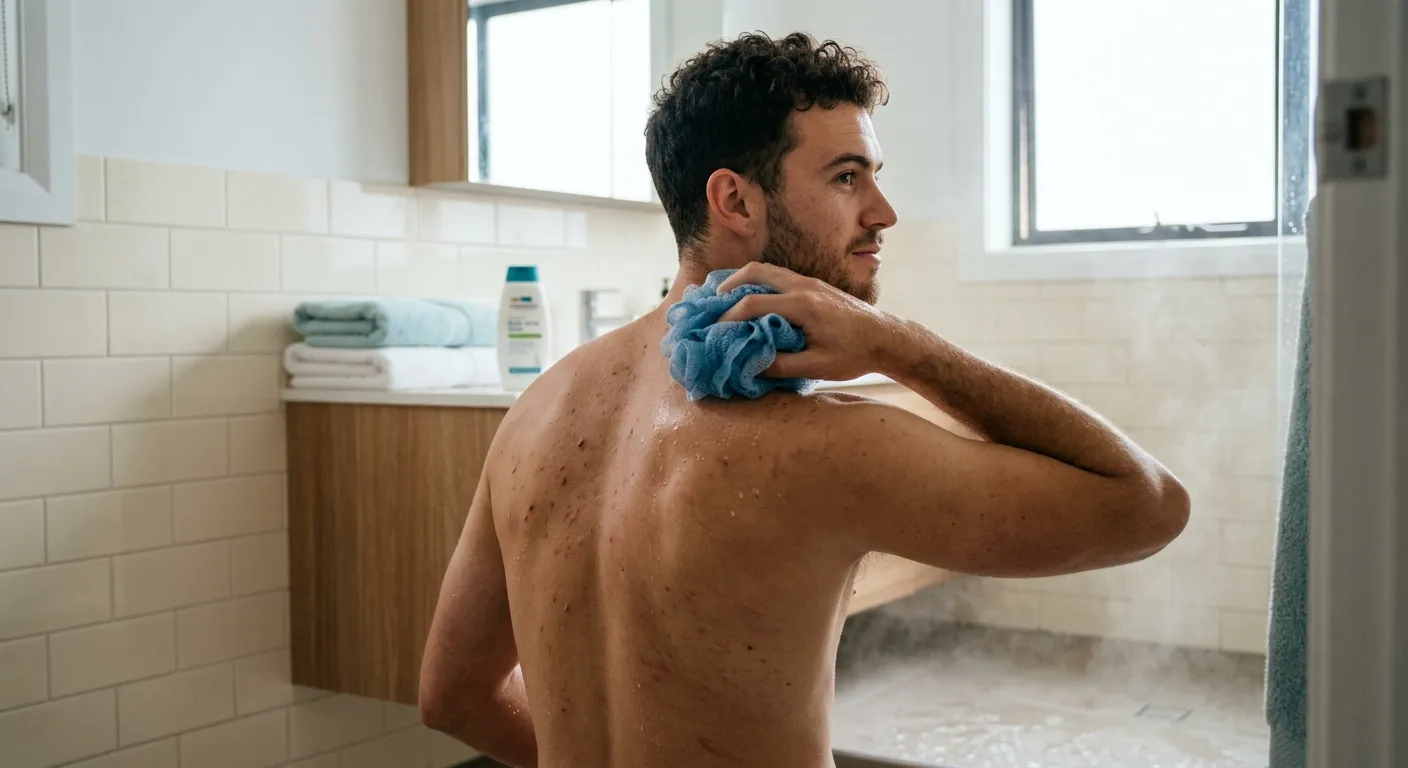
Back acne, often called bacne, is extremely common in Australian men because sweat, friction, and oil easily become trapped beneath clothing.
To reduce body acne:
If your bacne is painful, widespread, or leaving scars, it’s worth speaking with a GP or dermatologist and Avoid carrying heavy backpacks for long periods if you’re prone to bacne, as constant friction can worsen acne mechanica.
Shaving over active breakouts, or shaving incorrectly, is one of the most common (and most avoidable) causes of ongoing “acne” in men that’s actually irritation.
For the full breakdown, see our complete shaving routine guide, and browse our organic shave range built for sensitive, breakout-prone skin.
Yes. Inflamed acne—especially cystic or nodular acne—can damage the deeper layers of the skin and lead to permanent acne scars if left untreated or repeatedly picked.
Even when acne heals without scarring, many men notice lingering red or brown acne marks, known as post-inflammatory hyperpigmentation (PIH). These marks aren’t true scars, but they can take several months to fade, especially without daily sun protection.
The best way to prevent acne scars is to treat breakouts early, avoid squeezing pimples, follow a consistent skincare routine, and wear sunscreen every day to reduce darkening of healing skin.
Most mild to moderate acne responds well to a consistent home routine within 4–8 weeks. It’s time to speak to a dermatologist if:
A dermatologist can prescribe topical or oral treatments (like prescription-strength benzoyl peroxide, retinoids, or in more severe cases, isotretinoin) that go beyond what an at-home routine can achieve. Natural skincare remains valuable here too — it supports the skin barrier while stronger treatments do the heavier lifting.
If you want to build the full routine in one go rather than buying pieces separately, our Complete Skincare Set for Men bundles the cleanser, scrub, mask, moisturiser and serum oil from this guide into one kit — a straightforward way to start an acne-fighting routine without the guesswork. It’s also one of our most gifted bundles; browse the full range of men’s grooming gift sets if you’re stocking up for yourself or someone else.
Prefer to build your own routine product by product? Explore our full organic face care range, or browse everything in the shop. If breakouts extend to your back, shoulders or chest, pair your face routine with products from our body care range. And if razor bumps are part of the problem, our accessories range includes the shaving tools that make a proper technique easier to stick to.
Remember that even the best skincare products won’t clear acne overnight. Consistency and patience are far more important than using multiple treatments at once.
Medical disclaimer: This article is general information, not medical advice. If you have severe, painful, or persistent acne, please consult a GP or dermatologist for a personalised treatment plan.