
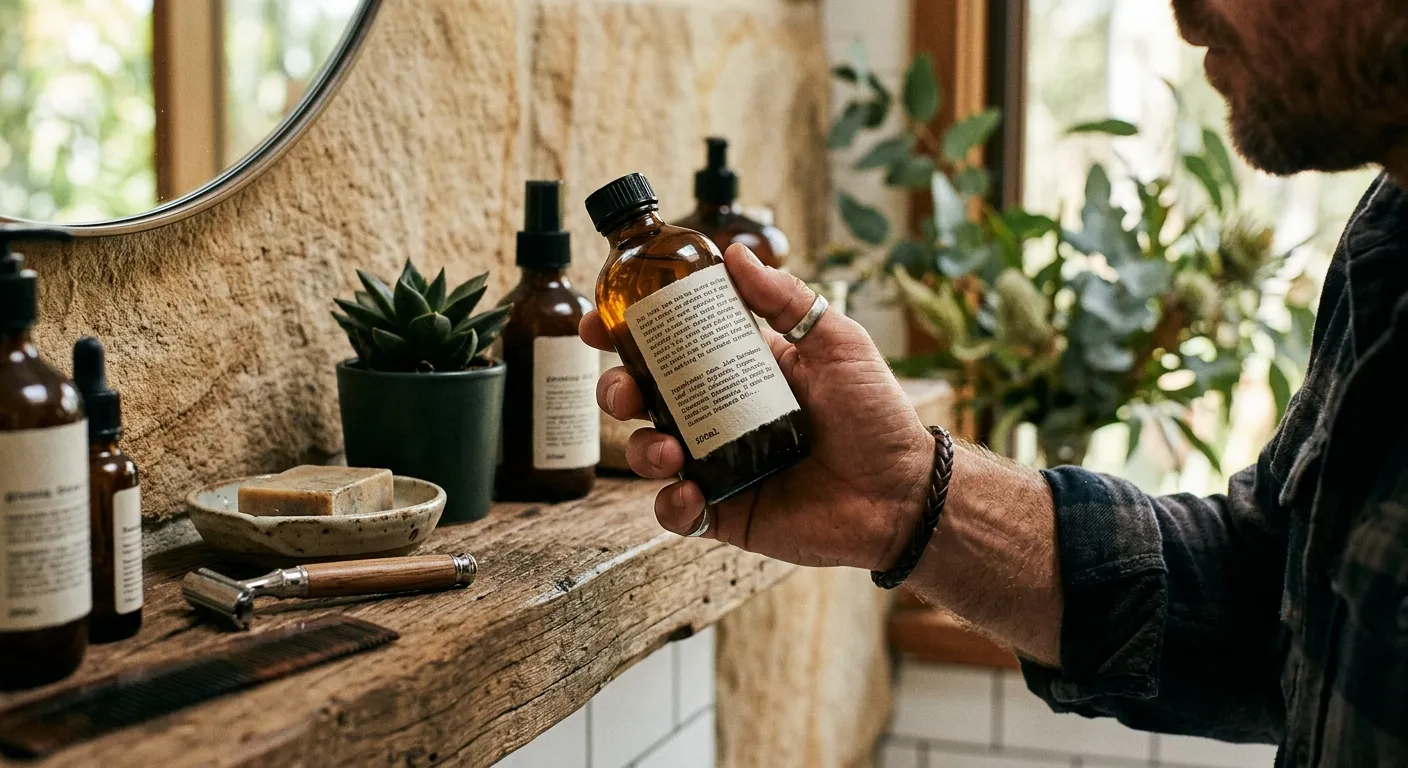
You’re standing in the shower aisle — or scrolling a website at 11pm — looking at a bottle that says “organic” in big green letters. Underneath it, in smaller print, there might be a logo you don’t recognise. Or there might be nothing at all. So is it actually organic, or is that just the word doing some heavy marketing lifting?
Here’s the short version: In Australia, the term “organic” isn’t legally protected for products sold domestically, meaning businesses may use the term without obtaining third-party certification, provided their claims aren’t misleading under Australian Consumer Law. By contrast, “certified organic” means an independent certification body has verified the product against a recognised standard.
This guide breaks down exactly what certified organic means, which certifications actually matter in Australia, and how to spot a label that’s dressing up in organic language without earning it.
Most men have never had a reason to think about certification bodies — and honestly, most brands don’t make it easy either. Here’s the part that trips people up:
Australia has no law requiring domestic cosmetic products labelled “organic” to hold third-party organic certification.
The National Standard for Organic and Bio-Dynamic Produce is mandatory for exported organic goods, but for products sold within Australia, a brand can legally slap “organic” on a bottle with zero independent checks.
That’s not necessarily a scam — plenty of small, honest brands use genuinely organic ingredients without paying for formal certification, because the certification process is expensive and slow. But it does mean the word alone tells you nothing. The only way to get an actual guarantee is to look for a certification mark from a recognised body, because “certified” is the one part of the claim that is regulated — a brand can be pursued for falsely claiming certification it doesn’t hold.
This is exactly the gap that lets vague, feel-good words creep onto shelves. Before we get to the real certifiers, it helps to separate the words that sound similar but mean very different things.
These three words get used almost interchangeably in grooming marketing, but only one of them comes with an independent check.
| Term | What It Actually Means | Independently Verified? |
|---|---|---|
| Natural | Contains ingredients derived from nature at some point. No defined percentage, no standard. | No |
| Clean | Free from a brand’s own chosen list of “bad” ingredients (varies brand to brand). No legal definition. | No |
| Organic (uncertified) | The brand claims the ingredients are organically grown, but the claim hasn’t been independently verified. | No |
| Certified Organic | Audited against a recognised standard (e.g. ACO, NASAA, COSMOS). Usually requires 95%+ organic content. | Yes |
The takeaway: “natural” and “clean” are marketing language, not standards. If a product only uses those words, that’s not automatically bad — but it does mean you’re taking the brand’s word for it.
If a product wants to earn your trust with the word “organic,” it should be able to show you which certifier stands behind that claim.
want to go deeper on what specific ingredients actually do for your skin and hair?(rather than just how they’re farmed), our ingredients guide breaks down the certified organic plant oils and extracts we use, one by one.
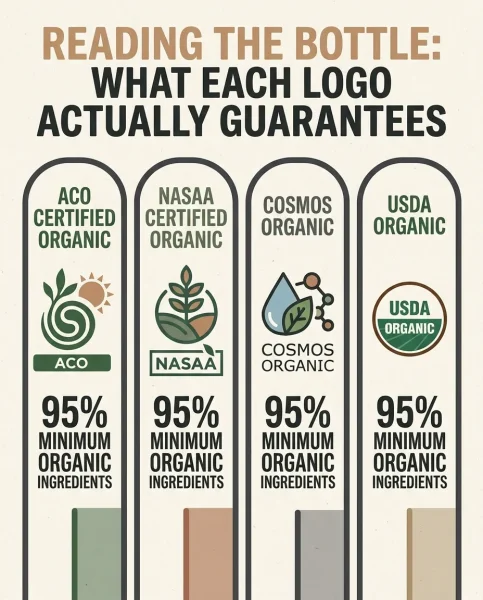
There are a handful of certifiers that show up repeatedly on Australian grooming and skincare labels. Here’s what each one means, in plain terms.
| Certifier | What It Covers | Typical Requirement |
|---|---|---|
| ACO (Australian Certified Organic) | Australia’s largest and most recognised certifier — food, cosmetics, textiles. Owns the “Bud” logo. | 95%+ certified organic ingredients (excl. water) for the “Certified Organic” tier |
| NASAA (National Association for Sustainable Agriculture Australia) | One of Australia’s oldest certifiers, strong in agricultural and skincare certification. | 95%+ for “Certified Organic,” 70%+ for “Approved Cosmetics” tier |
| COSMOS Organic | International cosmetics-specific standard, recognised across the EU and used by some Australian brands. | At least 95% of plant-based ingredients organic, 20%+ of total product organic |
| USDA Organic | US-based, sometimes seen on imported or export-oriented Australian brands. Mutual recognition exists with Australian standards. | 95%+ organic content |
A useful rule of thumb: if a brand is genuinely certified, they’ll usually be proud of it — the logo will be visible on the bottle or clearly linked to a certificate on their website, not buried in a footnote. You can independently verify a brand’s certification status directly through ACO’s certification database or NASAA’s website if you want to be thorough.
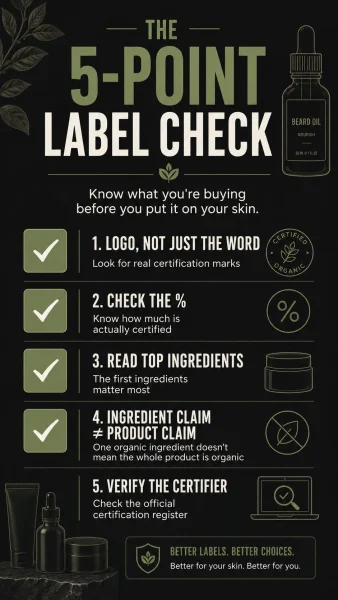
Next time you pick up a bottle — beard oil, shampoo, shave cream, whatever — run it through this quick sequence.
The word can be printed by anyone. The logo can’t — it’s licensed to certified operators only. No logo, no independent proof.
Some labels say “contains organic ingredients” — which can be true even if only 1% of the formula is organic. That’s very different from a product that’s certified organic overall. If a brand is proud of a high percentage, they’ll usually state it directly.
Ingredients are listed in descending order of concentration. If water (aqua) is first and a certified organic oil is buried near the bottom next to preservatives, that “organic” hero ingredient is doing more for the marketing copy than for your skin.
“Made with organic aloe vera” can be 100% true and still describe a product where everything else is synthetic. That’s not dishonest, but it’s not the same as a certified organic product.
A quick search of the certification body’s public register takes thirty seconds and settles the question for good.
Men’s grooming is a newer category than women’s skincare, and it shows — the label game is often sloppier, which cuts both ways. Some tricks to watch for specifically:
Organic-inspired branding using leaves, forests, earthy colours, or nature-themed imagery to imply organic quality without certification.
None of this means every uncertified product is a scam. Small-batch brands often use excellent, genuinely organic ingredients without paying for formal certification because of the cost and admin involved. The point isn’t to distrust everything — it’s to know which claims you can verify and which ones you’re taking on faith.
This isn’t just a technicality. Australian men deal with a specific combination of stressors that make ingredient selection becomes especially important than most labels let on: daily UV exposure, sweat from work or training, razor irritation, and — for a lot of guys — a beard trapping heat, oil, and dead skin against the jaw. If you’re already dealing with common skin problems Australian men face, the last thing you need is a product loaded with synthetic fragrance or harsh preservatives marketed as “natural” when it isn’t independently checked.
Certified organic cold-pressed plant oils naturally retain beneficial fatty acids and plant compounds while meeting strict standards for organic production.
If you want to see what that looks like in practice, our Beard range, Face range, and Body range are all built around certified organic cold-pressed plant oils and extracts rather than non-active filler ingredients — you can check the full ingredient breakdown on any product page before you buy.
Before you add a “organic” grooming product to your cart, ask:
Every product across our shop is built on certified organic, cold-pressed plant oils rather than synthetic filler — including our Gift Sets if you’re shopping for a mate who needs the same wake-up call about his shower shelf, and our grooming Accessories if you’re rounding out a full routine.
Want to see certification in action rather than just read about it? Browse our full range of certified organic men’s grooming products, made in Australia — or start with the Ingredients page to see exactly what’s in every bottle.
This article is based on guidance from Australian Certified Organic (ACO), NASAA Certified Organic, COSMOS, and the Australian Consumer Law framework governing misleading environmental claims.