

Most men don’t notice skin ageing until it’s already well underway — not because it happens suddenly, but because men are far less likely to track their skin the way they’d track, say, a gym routine. By the time it’s obvious in the mirror, the changes have usually been building for a few years.
The good news: the first signs are specific, predictable, and — if you catch them early — genuinely manageable with the right habits. This guide covers exactly what to look for, why men’s skin ages differently (and often faster in the sun-heavy Australian climate), and which changes to your routine actually make a measurable difference.
Understanding the first signs of ageing in men’s skin makes it easier to slow premature ageing before deeper wrinkles and permanent sun damage develop.
| Question | Short Answer |
|---|---|
| What shows up first? | Fine lines around the eyes, early loss of firmness along the jaw, and sun spots or uneven tone |
| Why does it happen sooner in Australia? | UV exposure is the single biggest driver of visible skin ageing — and Australia has the highest UV levels in the world |
| Single most effective habit | Daily SPF — more impactful than any serum or cream |
| What actually helps beyond SPF | Vitamin C, hydration (hyaluronic acid/jojoba), gentle exfoliation, consistent eye-area care |
| Is it too late once you notice it? | No — most early signs respond well to a consistent routine started now |
Many men assume wrinkles are simply a natural part of getting older, but dermatology research paints a different picture. Experts estimate that up to 80–90% of visible facial ageing is linked to cumulative UV exposure rather than ageing alone, making sun protection one of the most effective long-term investments in healthier-looking skin. At the same time, collagen production gradually declines by around 1% each year from the late twenties onward, meaning small daily habits become increasingly important long before deep wrinkles appear.
First Signs of Skin Ageing in Men Include:
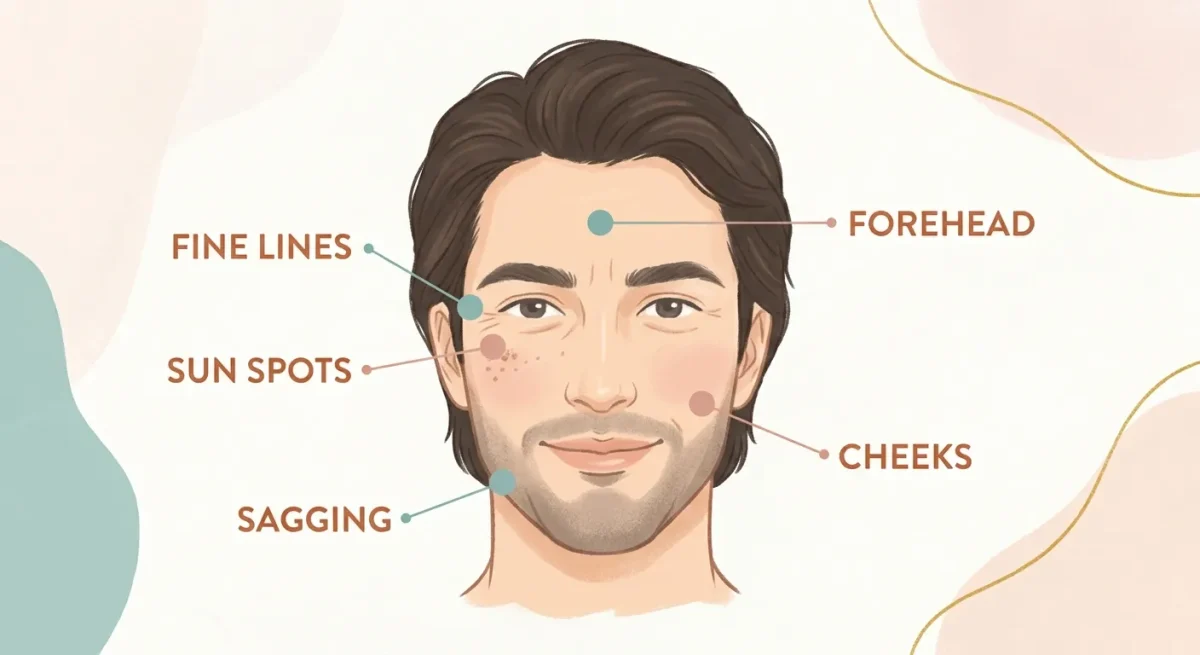
The skin around the eyes is thinner and has fewer oil glands than the rest of the face, which is why fine lines almost always show up here first — often in your early-to-mid 30s for men who spend time outdoors or squint in bright light regularly.
Common early signs around the eyes include:
Although these changes are subtle at first, they often provide the earliest indication that collagen and moisture levels are beginning to decline.
A slight softening along the jawline, sometimes described as “losing definition,” is usually one of the earliest structural changes, driven by a gradual decline in collagen production that typically becomes noticeable from the mid-30s onward.
Small patches of darker pigmentation on the cheeks, forehead, or backs of the hands are a direct visual record of cumulative sun exposure, and in Australia they frequently appear earlier than international skincare guides account for.
Skin that used to bounce back and look fresh after a rough night starts taking longer to recover — a sign that cell turnover is slowing and the skin barrier isn’t retaining moisture as efficiently as it used to.
Unlike fine lines around the eyes, these come from repeated muscle movement over years combined with reduced skin elasticity, which is why they tend to appear a few years after the first crow’s feet.
| Early Sign | Usually Appears | Main Cause | Best First Step |
|---|---|---|---|
| Crow’s feet | Early–mid 30s | Collagen decline + repeated facial movement | Daily SPF, eye serum, hydration |
| Uneven skin tone | 30s+ | UV exposure | Vitamin C, SPF |
| Loss of jawline firmness | Mid 30s–40s | Reduced collagen and elastin | Moisturiser, antioxidants, healthy lifestyle |
| Rough texture | Any age | Slower cell turnover | Gentle exfoliation, hydration |
| Forehead lines | Late 30s–40s | Facial expressions + collagen loss | SPF, moisturiser, retinoids (if suitable) |
Skin ageing is a gradual process influenced by both genetics and lifestyle. While everyone ages differently, daily habits—especially UV exposure, smoking, sleep quality and skincare—play a major role in how quickly visible changes appear.
Collagen production begins to decline gradually, although most men won’t notice visible changes yet. This is the best time to build habits like daily SPF and regular moisturising.
Fine lines, slower skin recovery and the first signs of uneven tone may begin to appear as cell turnover slows. Adding antioxidants such as Vitamin C can help support healthier-looking skin.
Collagen and elastin decline further, making wrinkles, reduced firmness and pigmentation more noticeable. Consistent hydration, sun protection and barrier support become increasingly important.
Skin retains less moisture and repairs itself more slowly, leading to deeper wrinkles and rougher texture. A simple routine focused on SPF, hydration and gentle skincare helps maintain healthier-looking skin.
Although these changes are a natural part of ageing, lifestyle has a significant impact on how quickly they become visible. Consistent sun protection, good hydration and a well-balanced skincare routine can noticeably slow the appearance of premature skin ageing over time.
Men’s skin is roughly 25% thicker than women’s, largely due to testosterone, and has higher collagen density, which is part of why visible ageing often starts a few years later in men. The trade-off is that once collagen decline begins, the change can look more sudden, because men are starting from a higher baseline and often haven’t built any preventative skincare habits in the meantime.
Men who shave regularly are mechanically removing a layer of dead skin cells several times a week, which can support smoother texture — but it’s not a substitute for proper exfoliation or moisturising, and shaving irritation itself can accelerate visible ageing if the skin isn’t cared for afterward.
This is less biology and more habit — and it’s the single biggest reason a lot of men see faster visible ageing than their skin’s natural biology would otherwise predict.
Not all skin ageing happens for the same reason.
Intrinsic ageing is the natural biological process driven by genetics and time.
Extrinsic ageing, on the other hand, is caused by outside influences such as UV exposure, smoking, pollution and lifestyle choices. For most Australian men, extrinsic ageing—particularly from sun exposure—has the greatest impact on how quickly wrinkles and pigmentation become visible.
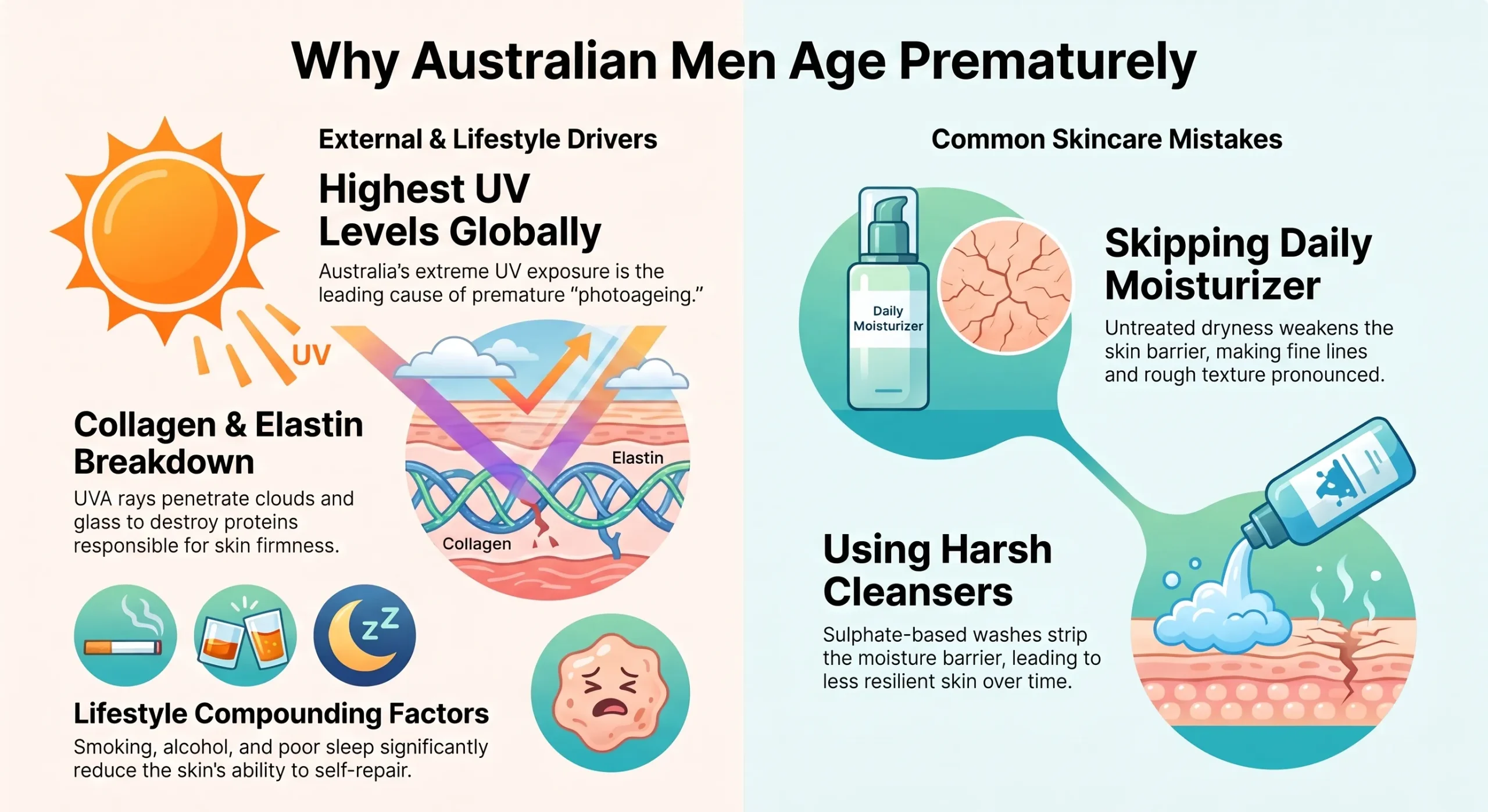
Sun damage is responsible for the vast majority of visible skin ageing, a process dermatologists call photoageing. UVA rays penetrate deep into the skin and break down collagen and elastin — the proteins responsible for firmness — while also being present year-round, even through cloud cover and glass, not just on obviously sunny days. According to Cancer Council Au, Australia has among the highest UV levels in the world, this single factor explains why Australian men often see visible ageing earlier than international skincare content assumes.
While UVA rays are primarily responsible for premature ageing, UVB rays contribute to sunburn and DNA damage, making broad-spectrum sunscreen essential for protection against both.
Untreated dryness weakens the skin barrier over time, making fine lines and rough texture more pronounced than they’d otherwise be — a totally preventable contributor that has nothing to do with genetics.
All three accelerate collagen breakdown and reduce the skin’s ability to repair itself overnight, compounding whatever sun damage has already occurred.
Stripping the skin with heavy, sulphate-based washes disrupts the moisture barrier daily, which — over months and years — adds up to visibly drier, less resilient skin.
Most men first notice UV damage because of wrinkles or dark spots, but the same ultraviolet exposure that accelerates visible ageing also increases the risk of skin cancer. Daily sun protection isn’t only about preserving a youthful appearance—it plays an important role in protecting long-term skin health. If you’d like to understand why SPF matters every day, read our guide to Why Men Need Sunscreen.

No serum or cream comes close to the impact of consistent daily sunscreen. Cancer Council Australia recommends a broad-spectrum SPF50 or SPF50+ applied generously and reapplied every two hours during exposure — a habit that does more to prevent visible ageing than any other single step. Pair it with a lightweight facial moisturiser underneath to keep skin hydrated through the day.
Antioxidants help neutralise the free-radical damage caused by UV exposure and environmental stress, supporting collagen production over time and helping even out tone and brightness.
Vitamin C also helps reduce oxidative stress caused by UV exposure, supports brighter-looking skin, and may gradually improve the appearance of uneven pigmentation when used consistently alongside daily sunscreen.
Ingredients like jojoba oil and plant-derived hyaluronic acid help the skin hold onto moisture rather than losing it throughout the day, which directly softens the appearance of fine lines and improves overall texture.
Keeping the skin barrier hydrated improves elasticity and helps minimise the appearance of fine lines, especially around the eyes where skin is naturally thinner. Our Face & Eye Serum Oil with jojoba and ginger is formulated specifically to target fine lines and brighten the delicate eye area where ageing tends to show first.
Removing built-up dead skin cells 1–2 times a week supports faster cell turnover and helps other products absorb more effectively, without over-stripping the skin the way daily harsh scrubbing would. A Face & Body Scrub with oatmeal and coconut is gentle enough for regular use without disrupting the skin barrier.
Because skin around the eyes is thinnest and shows change first, it deserves dedicated attention rather than whatever moisturiser happens to reach it during a full-face application — a targeted eye serum applied with light tapping motions makes a real difference here.
Build the habit of wearing broad-spectrum SPF every day and use a lightweight moisturiser to keep the skin barrier healthy.
Add an antioxidant serum, such as Vitamin C, while maintaining daily sunscreen use and regular hydration.
Focus on supporting collagen with consistent moisturising, gentle exfoliation and, if appropriate, ingredients like retinol under professional guidance.
Prioritise barrier repair, hydration and regular skin checks alongside your daily skincare routine.

Morning:
Evening:
For the complete day-to-day breakdown beyond just ageing-specific steps, see our full Skin Care Routine for Men. If your skin concerns extend to the body — chest, back, shoulders — our Men’s Body Skin Care Routine covers the same UV and hydration principles applied beyond the face.
Want it all in one system? The Complete Skincare Set for Men covers cleansing, hydration, and exfoliation in a single routine.
Retinol is one of the most studied ingredients for visibly reducing fine lines by speeding up cell turnover, but it can also cause dryness, peeling, and sun sensitivity — especially if introduced too aggressively. Many men see comparable improvements in texture and tone from a consistent routine built around vitamin C, gentle exfoliation, and daily SPF, without the irritation risk. If you do want to introduce retinol, start low-strength, use it only at night, and be even more consistent with SPF the next day, since retinol-treated skin is more UV-sensitive.
| Feature | Retinol | Vitamin C |
|---|---|---|
| Best time to use | Evening | Morning |
| Primary benefit | Speeds cell turnover | Protects against free radicals |
| Irritation potential | Moderate to high | Usually low |
| Helps improve | Fine lines, texture | Brightness, uneven tone |
| Prescription options | Yes | No |
| Needs daily SPF? | Absolutely | Recommended |
Myth: Wrinkles only happen to older men.
Fact: Sun damage begins accumulating from childhood, meaning the first visible signs often appear in the 30s rather than old age.
Myth: Expensive anti-ageing creams erase wrinkles.
Fact: Consistent sunscreen use and daily hydration generally have a greater long-term impact than expensive products used inconsistently.
Myth: Men don’t need moisturiser because their skin is oilier.
Fact: Oily skin can still become dehydrated. Maintaining the skin barrier helps minimise roughness and improves the appearance of fine lines.
Myth: Once wrinkles appear, nothing can help.
Fact: Early wrinkles often become less noticeable with regular sun protection, antioxidant skincare and proper hydration.
Most early signs of ageing respond well to a consistent at-home routine. It’s worth seeing a dermatologist if you notice a mole or spot that’s changing shape, size, or colour (which needs checking regardless of ageing concerns), if pigmentation is widespread and not improving after several months of SPF use, or if you want a professional assessment of options like prescription retinoids or in-clinic treatments beyond what skincare alone can achieve.
The first signs of skin ageing rarely appear overnight, and improving them takes patience for the same reason. The habits you build today—wearing sunscreen every morning, keeping your skin hydrated, supporting it with antioxidants and avoiding unnecessary irritation—will have a much greater impact than searching for a “miracle” cream years later.
Ageing is a natural part of life, but premature ageing doesn’t have to be. By recognising the earliest changes and responding with a simple, consistent routine, you can maintain healthier, stronger-looking skin for years to come.
If you’re just getting started, focus on the basics: cleanse gently, moisturise daily and never skip SPF. Small, consistent habits will always outperform complicated routines you can’t stick to.