

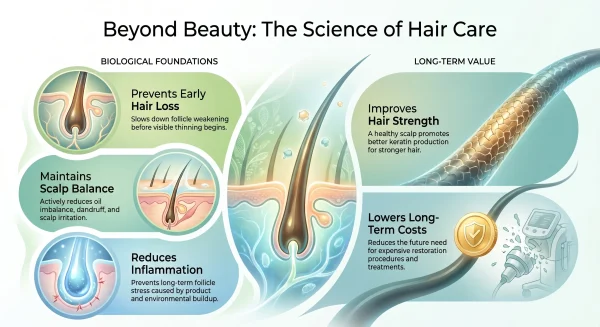
A hair care routine is not just about appearance—it’s essential for maintaining a healthy scalp and preventing long-term hair thinning.
Most hair problems in men don’t appear suddenly; they develop gradually through small daily habits like poor scalp hygiene, overwashing, stress, and product buildup. Over time, these issues disrupt the scalp environment and weaken hair follicles.
Healthy hair growth depends on a balanced scalp where follicles can function properly. When this balance is disturbed, signs like increased shedding, dandruff, oiliness, and reduced density often appear.
In simple terms, hair care is preventive maintenance—not a reaction to hair loss. Consistent care helps keep the scalp stable, supports stronger follicles, and reduces the risk of long-term hair issues.
A hair care routine for men is essential for maintaining scalp health and preventing long-term hair thinning.
It works by keeping the scalp environment balanced, allowing follicles to function properly and reducing excess shedding over time.
Without a routine, small daily imbalances—oil buildup, irritation, or inflammation—gradually weaken follicles and lead to thinning that often goes unnoticed until it becomes visible.
Most men don’t think about hair care until something goes wrong, like thinning hair, dandruff, or excessive oiliness. By that point, the issue has usually been developing silently for months.
Hair care is often treated as cosmetic. In reality, it’s preventive maintenance for your scalp, similar to how regular exercise maintains long-term physical health.
Read more at hair care mistakes about that.
Most men follow a reactive approach:
This delay allows minor scalp issues to evolve into long-term hair problems.
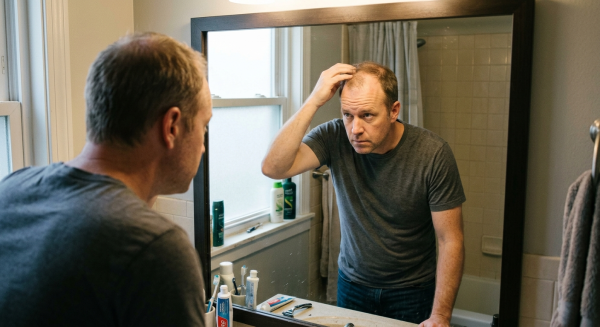
These signals are often dismissed but indicate underlying imbalance:
These are not random, they reflect scalp stress and disrupted follicle activity.
Hair strands are technically dead protein structures, which means they cannot repair themselves. The real control center is the scalp, where follicles grow and regulate the hair cycle.
When the scalp environment is disrupted:
Many common habits accelerate hair problems:
Using harsh shampoos can disrupt the scalp microbiome. Switching to an organic gentle sulfate-free shampoo can help restore balance.
A healthy scalp is the foundation of strong, stable hair growth. When this balance is disrupted, the entire hair cycle becomes less efficient.
An optimal scalp should be:
When this balance is lost, even strong genetics cannot fully protect against hair weakening.
Sebum is the scalp’s natural oil. In the right amount, it protects hair and maintains hydration. But imbalance creates problems:
Balanced sebum = stable scalp environment
Imbalanced sebum = higher risk of thinning and inflammation
Hair thinning is not random, it follows a biological pattern influenced by hormones, genetics, and scalp condition.
DHT (dihydrotestosterone) binds to sensitive hair follicles and gradually weakens them.
Over time:
Repeated exposure to DHT causes follicles to shrink.
Result:
Hair grows in cycles. The anagen phase is the active growth stage.
When scalp health declines:
A consistent routine is not cosmetic, it’s biological maintenance.
Leaving sweat on the scalp can lead to:
Chronic stress can:
Hair depends on:
Deficiencies lead to weaker, thinner hair.
Ignoring scalp health leads to gradual but persistent damage:
Complete your hair care routine with this shampoo and conditioner for men for everyday use.
Select products based on:
Not trends or marketing claims.
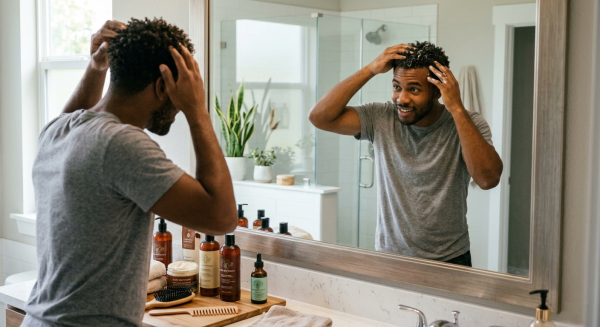
A simple routine done consistently is far more effective than a complex routine followed occasionally.
Want a clear, step-by-step plan tailored to your hair type? Read the complete step-by-step men’s hair care routine guide
Leads to dryness, irritation, and oil rebound
Focusing only on hair strands misses the root cause
Different scalps require different care strategies
Hair Care Is a Long-Term Strategy, Not a Reaction
Hair health is built over time through small, consistent habits, not quick fixes.
Most hair problems in men are not sudden, they are the result of repeated neglect and imbalance over time.
A consistent hair care routine for men is one of the most effective ways to protect long-term hair health.
Key Takeaways
Start simple. Stay consistent. Think long-term.